Your team isn't rejecting AI. It's unsure.
On September 8, 2026, Ralf Strauß published figures from the Marketing Tech Monitor 2026 on t3n. He is the publisher of that study. It surveyed about 1,600 decision makers in Germany, Austria and Switzerland, plus 2,800 employees. One comparison from it has stayed with me.
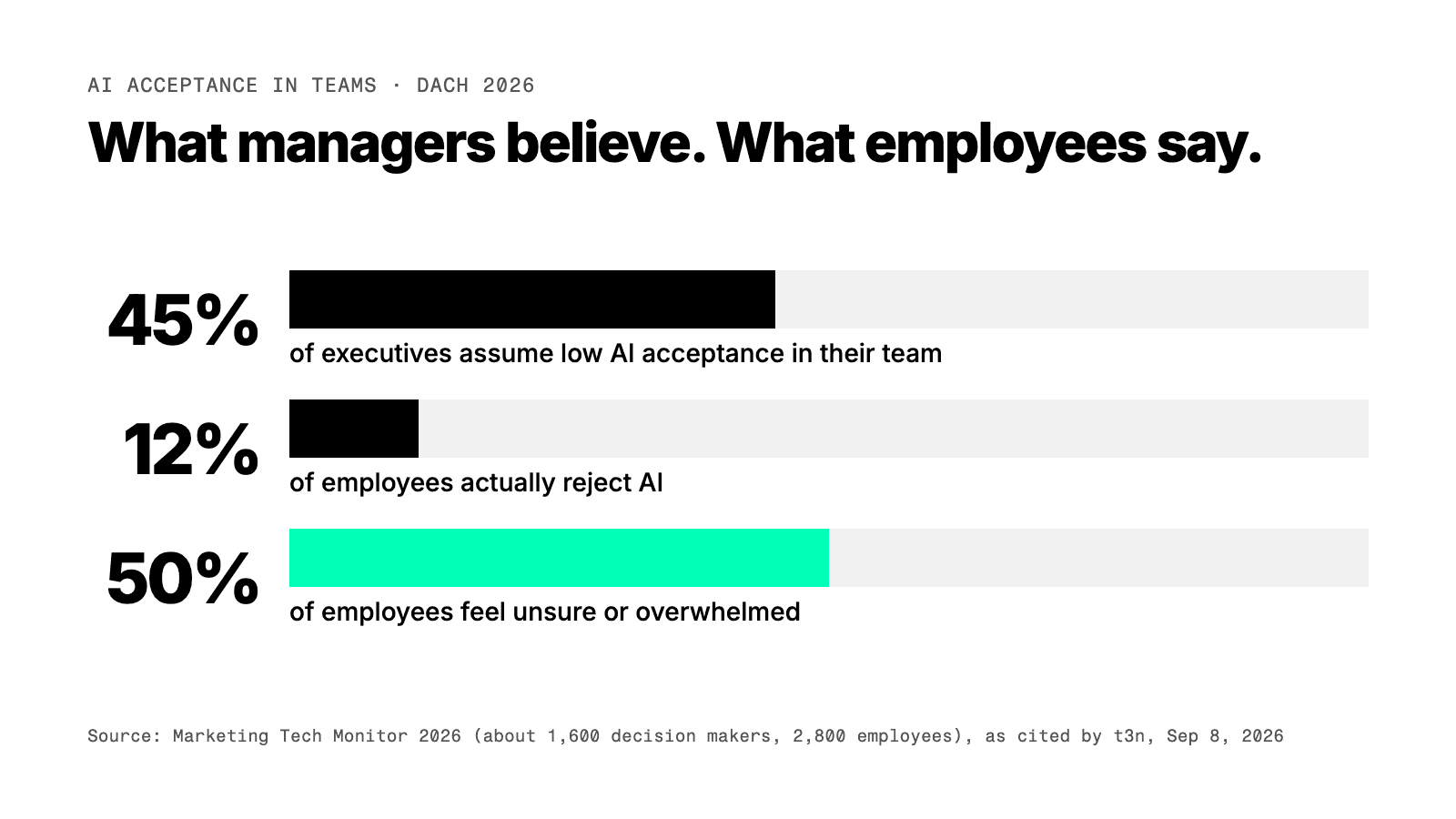
45 percent of executives say their employees have rather low acceptance of AI. Ask the employees themselves and only 12 percent admit to real rejection. 50 percent feel unsure or overwhelmed (t3n, Sep 8, 2026).
Two diagnoses, two treatments
Rejection and uncertainty look identical from the outside. In both cases the new tool sits unused, the license keeps running, and nobody speaks up in the meeting. If you read that as resistance, you reach for persuasion: a town hall, a vision, one more deck about the future of work.
Someone who is unsure needs something else. They want to know which of their tasks they will do differently with Claude or ChatGPT tomorrow morning, what they are allowed to paste in, and what happens when the output is wrong. A vision doesn't answer that. A set of instructions does.
Leadership says so itself
The same article confirms it. 67 percent of the executives surveyed admit that the benefit of new tools is not communicated clearly. And 56 percent name insufficient functional or subject-matter understanding as the main reason projects fail.
Read those together. Two thirds know the benefit isn't being explained. Still, almost half settle on the reading that the team is just skeptical. That reading is comfortable because it puts the problem on someone else's desk.
Enablement beats rollout
A rollout answers who has access. Enablement answers what someone does with it on Monday. After almost 20 years in product work I know this pattern from every software launch: access is the cheap part.
What belongs to enablement, in my view:
- One use case per role. For example: sales summarizes customer calls with Claude. "AI for everyone" is not a use case.
- Clear rules on what goes in. Customer data yes or no, which tool is approved. A lot of hesitation starts right here.
- Permission to get it wrong. People who fear being caught with a bad AI result will just not use it.
- Someone to ask. A person on the team, not a hotline.
I can't give you my own evidence from trainings yet. I don't have a before-and-after measurement, and without a number this stays my assessment.
The counterargument
I take three objections seriously.
First, the figures come from a guest article by the study's own publisher. Method and survey period are not in the article, and someone who consults on marketing technology has an interest in exactly this reading.
Second, it is self-reported. If you fear for your job, you tick "unsure" before you tick "against", because it is harder to hold against you. Real resistance may be higher than 12 percent.
Third, uncertainty can be justified. If someone fears AI will cost them their position, a prompting workshop won't solve it. What's missing then is an honest answer from leadership about what happens to the roles.
I'm keeping the thesis anyway. Even if real rejection were twice as high, the unsure would still be the largest group.
What this means for you
If you lead a team, ask before you diagnose. "What keeps you from using this?" gets you more in ten minutes than any assumption about acceptance. And for every license, plan at least one concrete task that gets done with it.
If you are the one who feels unsure, you are in the largest group. That is the normal case. Take one task you do every week and try it once with Claude or ChatGPT. One is enough to start.
Sources:
- Ralf Strauß: 85 Prozent scheitern: Warum das größte Problem bei KI-Projekten nicht die Technik ist, t3n, Sep 8, 2026, in German (figures from the Marketing Tech Monitor 2026)