Building is no longer the bottleneck. Deciding is.
On November 17 I had 20 topics and 11 finished briefs for new content on my desk. My agents had prepared them. They got stuck with me, because I couldn't decide which ones to shoot.
Two years ago it would have been the other way around. I would have had three ideas and needed two weeks to execute one of them.
The number, handled with care
Product management vendor airfocus put it this way in March 2026: developers can accelerate 100 percent of their coding work with AI, product managers maybe 30 percent. The remaining 70 percent has built-in slowness, namely stakeholder loops, alignment and discovery calls (airfocus, Mar 11, 2026).
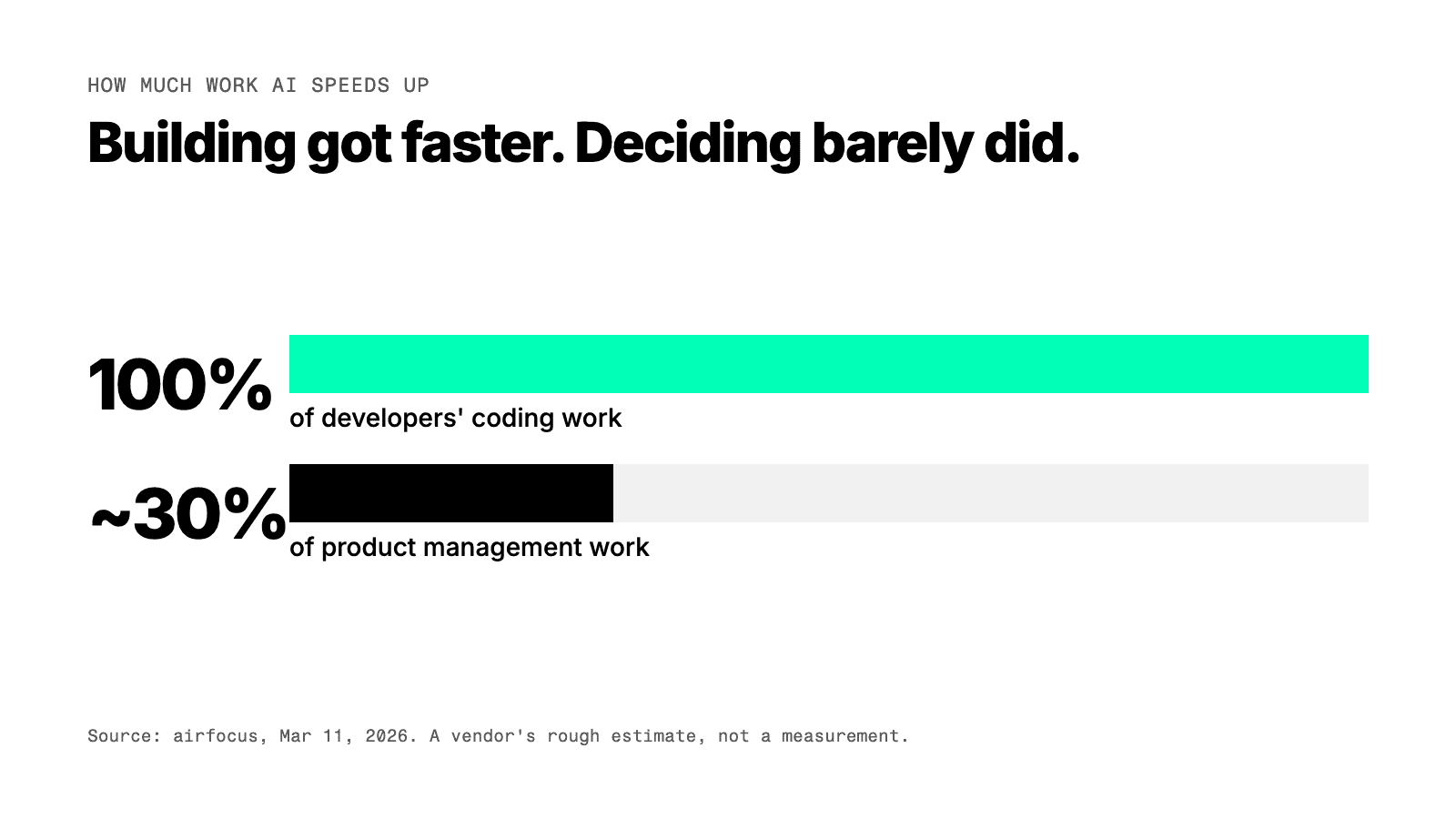
One caveat matters here: this is not a measurement. The article cites no study, no sample and no method, and it comes from a company that sells software to product managers. I treat the 30 percent as a rule of thumb. It still matches my day-to-day fairly well.
Why deciding doesn't keep up
Code gets feedback in seconds. The test is green or red, and Claude Code keeps trying until it is green. A product decision gets its feedback in weeks, and it comes from the market.
There is a second effect. An agent hands you ten variants in ten minutes. Choosing among ten is harder than choosing among three. airfocus describes the same thing for teams: shipping faster creates more work around launches and alignment, and that work lands in product management.
What it looks like for me
I work solo with agents across three brands. Research, drafts, code and graphics run in parallel. The part that doesn't run in parallel is me. Every approval crosses my desk, and that is on purpose: nothing goes out without my go.
As a result, my day is less about making and more about selecting, rejecting and prioritizing. Three things help:
- Set criteria before building. Before an agent starts, I know what I'll judge the result against. Afterwards the decision is a comparison and no longer a brooding session.
- Order fewer options. I ask for one proposal with a rationale. Five variants to pick from cost me more time than they save.
- Batch decisions. Approvals have a fixed slot in the day. In between I only decide what is truly urgent.
I haven't measured the effect. It is my impression after a few months, nothing more.
The counterargument
The first objection targets the number. 100 and 30 percent are a rough estimate from a vendor with skin in the game, as noted above. Turning that into a statistic stretches it too far.
The second targets my vantage point. As a solo builder I have no legacy systems, no peer code reviews and no compliance department. In a company with a grown codebase, building stays the bottleneck in many places: reviews, tests, deployments, security.
The third is more fundamental. Deciding has always been the hard part, and slow execution merely hid it. If you waited two weeks for a feature, you had two weeks to think. I agree with that. What's new for me is that the waiting time is gone and the decision now sits there in plain sight.
What this means for you
If AI lets you build faster, check where the queue is now. Count once: how many finished drafts, prototypes or texts are waiting for your okay? If that number is larger than the number of things still to be built, you know your bottleneck.
As for which skill is worth investing in: judgment and prioritization. I wrote down how to hand work to AI in 6 levels of steering AI. Which work is worth handing over is still yours to know.
Sources:
- Emma-Lily Pendleton: Is product management becoming a bottleneck for AI?, airfocus, Mar 11, 2026 (with Malte Scholz, Head of Product and co-founder of airfocus)